Key Points
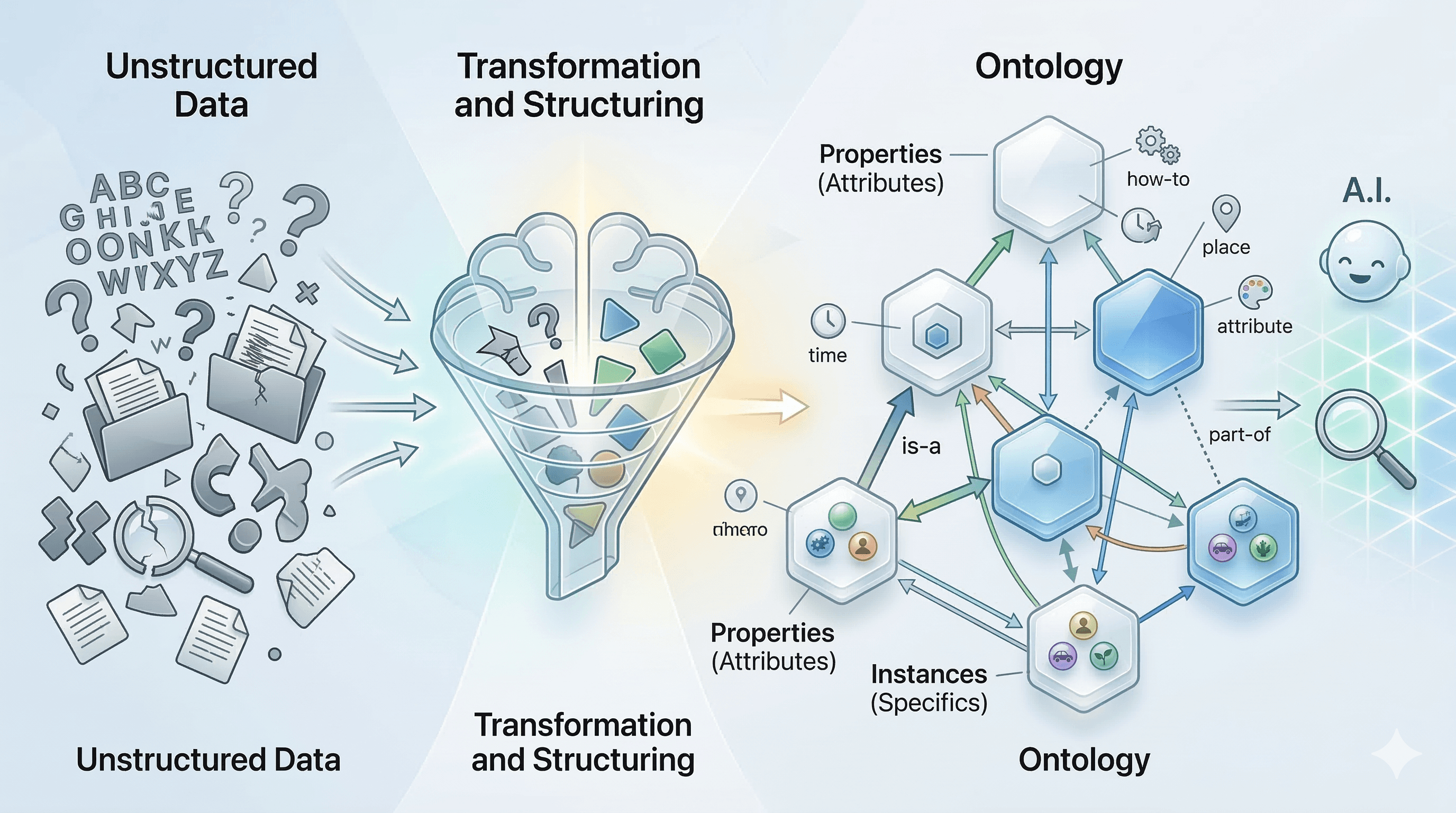
- Integrate fragmented enterprise data (CRM, ERP, Legacy DB) through ontology
- Provide deterministic answers based on explicit relationships, not probabilistic guessing
- Implement social intelligence where all agents share a common ontology
- Build a customized enterprise operating system that fully understands business context
voidX Ontology: Deterministic AI Challenging 0% Hallucination
voidX Ontology connects fragmented enterprise data through ontology to provide hallucination-free deterministic AI responses. A new paradigm supporting business decisions with explicit relationship-based logic, not LLM statistical guessing.
Beyond Probabilistic Guessing, Proving with Deterministic Logic#
Large Language Models (LLMs) demonstrate remarkable capabilities, but have fundamental limitations. Because they predict "plausible next words" based on training data, they cannot avoid the hallucination problem—confidently generating information that contradicts facts.
As Anthropic's AI alignment research[1] mentions, AI system safety and accuracy are the most critical challenges in enterprise environments. "Plausible guessing" becomes a serious risk in business decision-making.
voidX Ontology fundamentally solves this problem.
Ontology: AI's 'Semantic Map'#
What is an Ontology?#
According to IBM's technical documentation[2], an ontology is not a simple database. It's a knowledge structure that explicitly defines concepts and their relationships.
For example:
- "John Smith" belongs to "Sales Team"
- "Sales Team" is responsible for "Q1 Revenue Target"
- "Q1 Revenue Target" is related to "Project A"
When such explicit relationships are defined, AI derives answers through logical reasoning, not guessing.
LLM vs Ontology-based AI#
| Aspect | LLM (Probabilistic Guessing) | Ontology (Deterministic Logic) |
|---|---|---|
| Answer Generation | Pattern prediction from training data | Logical reasoning from explicit relationships |
| Accuracy | High but hallucination risk | 100% accurate within defined scope |
| New Information | Dependent on training data | Real-time data reflection |
| Explainability | Black box | Full reasoning path traceability |
3 Core Principles of voidX Ontology#
1. Transforming Fragmented Data into Organic Intelligence#
Enterprise data is scattered:
| Upper Data Sources | ||
|---|---|---|
| CRM | ERP | Legacy DB |
| ↓ | ↓ | ↓ |
| ⬇ Ontology Core ⬇ | ||
| ↓ | ↓ | ↓ |
| Cloud | Docs |
💡 Key Point: All data connects through Ontology Core, gaining semantic meaning.
voidX Ontology integrates all data sources—CRM, ERP, Legacy DB, Cloud, documents, email—into a single knowledge graph. Not just a sum of information, but a customized enterprise operating system that fully understands business context.
2. Only Verified Truth, Not Plausible Probability#
According to Neo4j's 2025 report[3], graph-based AI systems achieve high accuracy in enterprise domains. This is a meaningful improvement compared to using LLM alone.
voidX Ontology answers:
- Derived from explicit relationships: Logical proof, not guessing
- Traceable reasoning path: Fully explains "why this answer"
- Immediate error detection: Responds "I don't know" for undefined relationships
3. Agent Network Sharing Intelligence#
All voidX agents share a common ontology. This is not simple data sharing, but social intelligence.
- Feedback collected by Customer Agent reflects in Product Agent's recommendations
- Success patterns from Sales Agent utilized in Marketing Agent's strategy
- Issues identified by CS Agent influence Development Agent's priorities
Based on synchronized knowledge, business processes self-optimize.
Integration with Existing Systems#
voidX Ontology doesn't replace existing infrastructure. It can be layered on top for immediate use.
Supported Data Sources#
| Data Source | Integration Method |
|---|---|
| CRM (Salesforce, HubSpot, etc.) | Direct API integration |
| ERP (SAP, Oracle, etc.) | Connector provided |
| Legacy Database | JDBC/ODBC connection |
| Cloud Storage (AWS S3, GCS, etc.) | File crawling |
| Documents (Google Drive, SharePoint, etc.) | OAuth integration |
| Email (Gmail, Outlook, etc.) | Optional integration |
Implementation Process#
- Data Source Connection (1-2 days): Connect existing systems via API/connectors
- Ontology Modeling (1-2 weeks): Define concepts and relationships for business domain
- Knowledge Extraction & Validation (1-2 weeks): Auto-extraction followed by expert validation
- Agent Deployment (Immediate): Start service immediately with Agent Casting
GraphRAG: Combining Ontology and LLM#
As Microsoft Research[4] demonstrates, combining knowledge graphs with language models is key to conversational AI. voidX advances this approach further:
- Ontology-based context: Provides accurate business context to LLM
- Graph traversal reasoning: Constructs logical answers following related nodes
- Real-time verification: Cross-validates generated answers with ontology
Getting Started with voidX Ontology#
Don't entrust your enterprise's future to probabilistic guessing. Design your business with deterministic intelligence.
- Request consultation at voidX AI
- Business domain analysis meeting
- Custom ontology design proposal
- PoC execution and effectiveness verification
Start hallucination-free enterprise AI with voidX Ontology.
Frequently Asked Questions
An ontology is a knowledge structure that explicitly defines concepts and their relationships. It's a 'semantic map' that enables AI to accurately understand the meaning and context of data.
📚 References
- 1🔬Academic PaperAnthropic (2025) Alignment Research. https://www.anthropic.com/research
- 2📄Technical DocumentationIBM (2025) What is a Knowledge Graph?. Retrieved March 10, 2026, from https://www.ibm.com/think/topics/knowledge-graph
- 3✍️Blog PostNeo4j (2025) 2025: Year of AI and Scalability. Neo4j Blog. https://neo4j.com/blog/news/2025-ai-scalability/
- 4🔬Academic PaperResearch, M. (2024) Knowledge Graphs and Linked Big Data Resources for Conversational Understanding. https://www.microsoft.com/en-us/research/project/knowledge-graphs-and-linked-big-data-resources-for-conversational-understanding/